
The Principles and Elements of Garden Design
A Complete Introduction to Creating Beautiful, Functional, and Timeless Gardens
Introduction: Garden Design as a Living Art
Garden design is often described as the slowest of the performing arts—and for good reason. Unlike painting or sculpture, where the work is fixed at the moment of completion, a garden is never truly finished. It grows, shifts, matures, and evolves with time. It responds to seasons, weather, and the subtle hand of the gardener. It is both an artistic composition and a living ecosystem.
In this way, a garden is a unique creative discipline. The “canvas” is three-dimensional. The “materials” are alive. And the “audience” doesn’t just observe—they step inside, move through it, and experience it from within.
This is what makes garden design so powerful—and so challenging.
Many people begin gardening by choosing plants they love and placing them wherever there’s space. And while that can create moments of beauty, it rarely produces a garden that feels cohesive, intentional, or deeply satisfying over time.
The difference between a collection of plants and a designed garden lies in understanding two fundamental ideas:
- The Elements of Design — the physical ingredients you work with
- The Principles of Design — the rules that guide how those ingredients are arranged
Together, these form the foundation of every successful garden, regardless of style—whether you’re creating a structured modern landscape, a naturalistic planting, or a romantic English cottage garden.
And perhaps most importantly: once you understand these fundamentals, you move beyond simply planting a garden…
and begin composing a landscape.
Part I: The Elements of Garden Design — The Ingredients
The elements of design are the tangible, visual qualities of everything you place in your garden. Plants, paths, walls, structures, water features—all of these express the core elements: line, form, texture, and color.
These are your raw materials. And like ingredients in cooking, how you combine them determines the final result.
1. Line: The Invisible Guide
Line is arguably the most powerful element in garden design because it controls how we move—both physically and visually—through a space.
It defines structure, directs the eye, and creates the underlying framework of the garden.
Different types of lines create very different emotional responses:
- Straight lines feel deliberate, formal, and controlled. They lead the eye directly and create a sense of order. You often see them in classical or contemporary gardens.
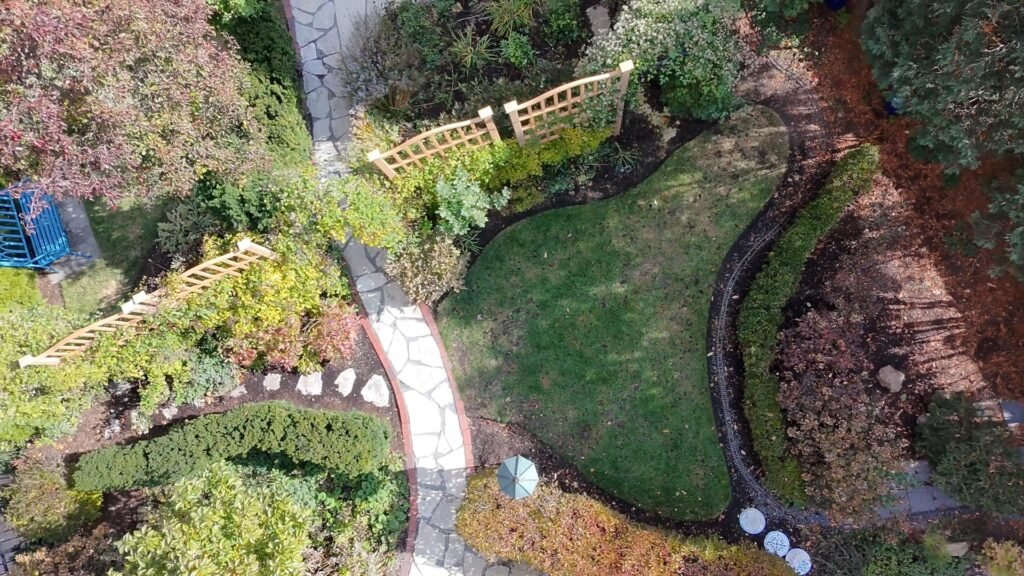
- Curved lines feel relaxed and natural. They slow the pace, encouraging exploration and discovery—perfect for informal or cottage-style gardens.
- Vertical lines (trees, arches, pergolas) draw the eye upward, adding drama and a sense of height.
- Horizontal lines (low hedges, walls, lawns) ground the space, creating calmness and stability.
In many ways, line forms the “skeleton” of your garden. Even the most relaxed, natural-looking space relies on carefully considered lines to guide movement and create coherence.
2. Form and Shape: The Architecture of the Garden
While line guides movement, form and shape define the physical presence of elements within the garden.
- Shape refers to the outline (2D)
- Form refers to the volume (3D)
Every plant and structure contributes a form:
- Rounded forms feel soft, calm, and natural
- Upright or columnar forms feel strong and formal
- Weeping forms suggest movement and tranquility
- Spiky or architectural forms add tension and drama
At a larger scale, form also applies to the layout of your garden:
- Circular lawns feel enclosed and intimate
- Rectangular patios feel structured and modern
- Free-flowing shapes feel organic and relaxed
Strong garden design often comes from contrasting forms—placing soft against rigid, tall against low, loose against structured.
3. Texture: The Subtle Layer of Depth
Texture is one of the most overlooked—but most important—elements in garden design.
It refers to how surfaces feel visually (and sometimes physically).
- Coarse textures (large leaves, bold foliage) feel strong and dominant
- Fine textures (delicate leaves, airy grasses) feel light and subtle
Texture influences how we perceive space:
- Coarse textures appear closer and make spaces feel smaller and more intimate
- Fine textures recede and make spaces feel larger and more open
The real magic happens in contrast. A bold-leaved plant next to a delicate grass makes both stand out more vividly.
Texture is what gives a garden richness—the difference between something that looks flat and something that feels layered and alive.