
Garden Design Philosophy
“My garden is my most beautiful masterpiece.” — Claude Monet
A garden is never just a collection of plants. It is not a static arrangement, nor a finished object. A garden is a living composition—something that grows, shifts, and evolves over time. It is shaped not only by the hands of the gardener, but by weather, seasons, light, and the quiet passage of years.
To design a garden, then, is to work in a medium unlike any other. It is to create with life itself.
At its best, garden design sits somewhere between art and nature. Like painting, it involves composition, balance, contrast, and rhythm. Like architecture, it shapes space and movement. But unlike either, it is never complete. A garden is always becoming.
This is what makes it both challenging and deeply rewarding: you are not designing an object—you are setting something in motion.
The Garden as Art
“The duty we owe to our gardens is to so use the plants that they shall form beautiful pictures.” — Gertrude Jekyll
One of the most powerful ways to understand garden design is to see it as a form of visual art. This was the great insight of Gertrude Jekyll, whose work transformed planting from simple horticulture into something painterly and expressive.
In a well-designed garden, plants are not just chosen—they are composed.
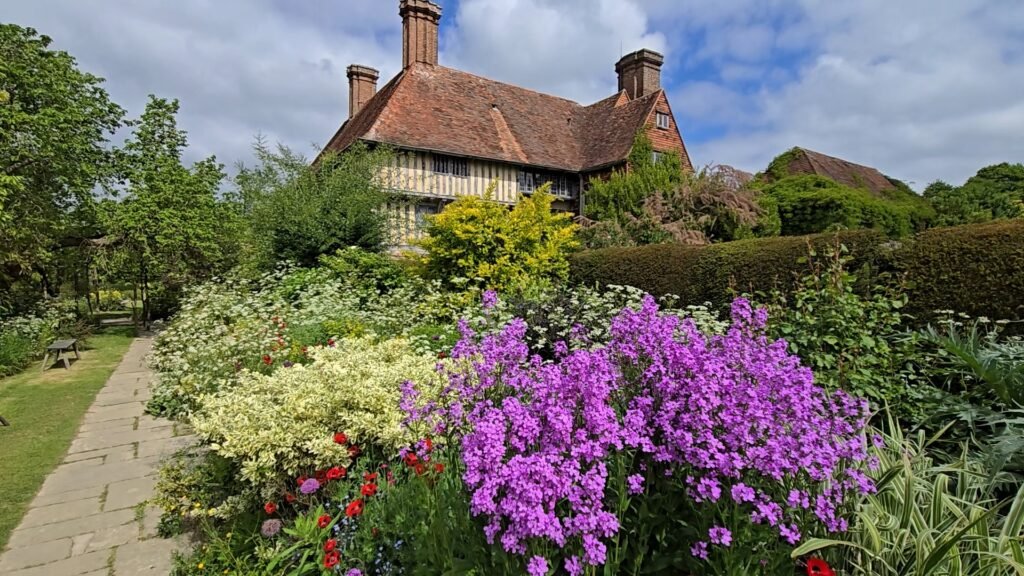
Color is layered like pigment on a canvas. Soft blues and silvers recede into the distance, while hot reds and oranges pull the eye forward. Texture creates contrast: the bold leaf of a hosta against the fine haze of ornamental grasses. Form gives structure—upright spires, rounded mounds, trailing edges—each playing its role in the overall composition.
But unlike a painting, this composition is not fixed. It changes with the seasons. A border that glows with spring bulbs gives way to summer abundance, then fades into autumn structure and winter silhouette.
Designing a garden means thinking not just in space, but in time.
Beyond a Collection of Plants
“Possession of plants… does not make a garden; it only makes a collection.” — Gertrude Jekyll
One of the most common mistakes in garden design is to focus on individual plants rather than the whole.
It’s easy to fall in love with a particular flower or shrub and want to include it. But a successful garden is not built from isolated choices—it emerges from relationships. Each plant must belong, contributing to a larger idea.
A garden becomes meaningful when there is cohesion:
- Repetition of forms or colors that create rhythm
- A limited palette that brings harmony
- Clear structure that guides the eye and the body
Without this, even the most beautiful plants can feel disconnected.
Design is what transforms a collection into a garden.
It is the invisible framework that holds everything together—the logic behind the beauty.
The Role of Restraint
“In garden arrangement… one has not only to acquire knowledge of what to do, but also wisdom in perceiving what it is well to let alone.” — Gertrude Jekyll
If there is one principle that separates good gardens from great ones, it is restraint.
Knowing what to include is important. Knowing what to leave out is essential.
In design, more is rarely better. Too many colors create confusion. Too many focal points compete for attention. Too many ideas dilute the impact of each one.
Restraint allows space for clarity.
It gives form to the garden’s identity, allowing each element to breathe and be appreciated. It also reflects a deeper understanding: that a garden is not improved by constant addition, but by thoughtful editing.
Often, the most powerful design move is not planting something new—but removing something that doesn’t belong.
The Gardener as Artist
“Every garden-maker should be an artist along his own lines.” — Vita Sackville-West
While principles matter, there is no single “correct” way to design a garden.
Each garden reflects the person who creates it.
Some are formal and structured, with clean lines and symmetry. Others are loose and naturalistic, blurring the boundary between cultivated and wild. Some are driven by color, others by texture, others still by atmosphere.
What matters is not adherence to a style, but authenticity.
A garden becomes compelling when it expresses a point of view—when it feels intentional and personal. This is where design moves beyond technique and becomes creative expression.
Like any art form, garden design invites experimentation. It evolves through trial and error, through observation and adjustment.
There is no final blueprint—only a continuous process of refinement.
Designing with Time
“The more one gardens, the more one learns… and the more one realizes how little one knows.” — Vita Sackville-West
A garden is never finished.
This is not a flaw—it is its defining characteristic.
Unlike a building or a painting, a garden grows. Plants mature, spread, and sometimes fail. Light patterns shift as trees develop. Soil changes. Climate varies from year to year.
Designing a garden, therefore, is not a one-time act but an ongoing relationship.
You learn by watching:
- How plants interact over time
- How spaces are used (or not used)
- How the garden feels in different seasons
Each year brings new insights, and with them, new opportunities to adjust and improve.
Patience becomes one of the most important design tools.
Hope, Optimism, and Imagination
“No gardener would be a gardener if he did not live in hope.” — Vita Sackville-West
Every garden begins with an idea—an imagined future.
You plant a tree knowing it will take years to reach its full form. You design a border anticipating how it will look in seasons yet to come. You shape a space with the belief that it will grow into something beautiful.
This act of imagining is at the heart of garden design.
It requires optimism. Not everything will succeed. Plants will fail, conditions will surprise you, and designs will need to evolve.
But this is part of the process.
A garden teaches resilience. It encourages you to try again, to adapt, to refine your vision.
In this way, design is not about control—it is about collaboration with nature.
The Meeting of Nature and Design
“The garden suggests there might be a place where we can meet nature halfway.” — Michael Pollan
A garden exists between two worlds.
It is not wild nature, but neither is it fully artificial. It is a space where human intention and natural processes intersect.
Design plays a crucial role in this meeting.
It shapes how we experience nature—what we see, how we move, where we pause. Paths guide us. Views are framed. Spaces open and close, creating a sense of journey.
At the same time, the garden remains alive and dynamic. It resists complete control, reminding us that nature is always an active participant.
The best gardens embrace this balance. They are designed, but not rigid. Structured, but not constrained.
They feel both intentional and natural.
Atmosphere and Emotion
“A garden must combine the poetic and the mysterious with a feeling of serenity and joy.” — Luis Barragán
Beyond structure and composition, a garden should evoke feeling.
This is often what distinguishes a technically competent garden from a truly memorable one.
Atmosphere is created through subtle design choices:
- The enclosure of a space and how it makes you feel
- The interplay of light and shadow
- The sound of water or rustling leaves
- The transition from one area to another
These elements are not always obvious, but they shape the emotional experience of the garden.
A well-designed garden invites you in. It encourages you to slow down, to notice, to linger.
It becomes not just something to look at, but something to inhabit.
Simplicity, Beauty, and Belief
“To plant a garden is to believe in tomorrow.” — Audrey Hepburn
At its core, garden design is an act of faith.
You work with materials that change, in conditions that are never fully predictable. You invest time and effort into something that will only reveal its full beauty gradually.
And yet, this is precisely what gives it meaning.
A garden connects us to cycles of growth and renewal. It reminds us that beauty is not instant, but cultivated over time. It offers a sense of continuity—a link between present effort and future reward.
Design gives shape to this process. It provides the structure within which growth can happen.
But ultimately, a garden is more than its design.
It is a place of experience, reflection, and connection.
The Principles and Elements of Garden Design
The Evolution of the English Garden
Awesome Small Space Garden Designs

Elements of English Cottage Garden Design

A Living Philosophy
Garden design is not just a set of rules or techniques. It is a way of seeing.
It asks you to observe closely, to think creatively, and to work patiently. It encourages both discipline and imagination. It teaches you to balance intention with acceptance, structure with freedom.
Above all, it reminds you that beauty is not something imposed—it is something cultivated.
A well-designed garden does not shout. It unfolds gradually, revealing its layers over time. It invites you to return, again and again, discovering something new with each visit.
And perhaps that is the true essence of garden design:
Not to create perfection, but to create a space that lives, grows, and continues to inspire.